


Elective Affinities
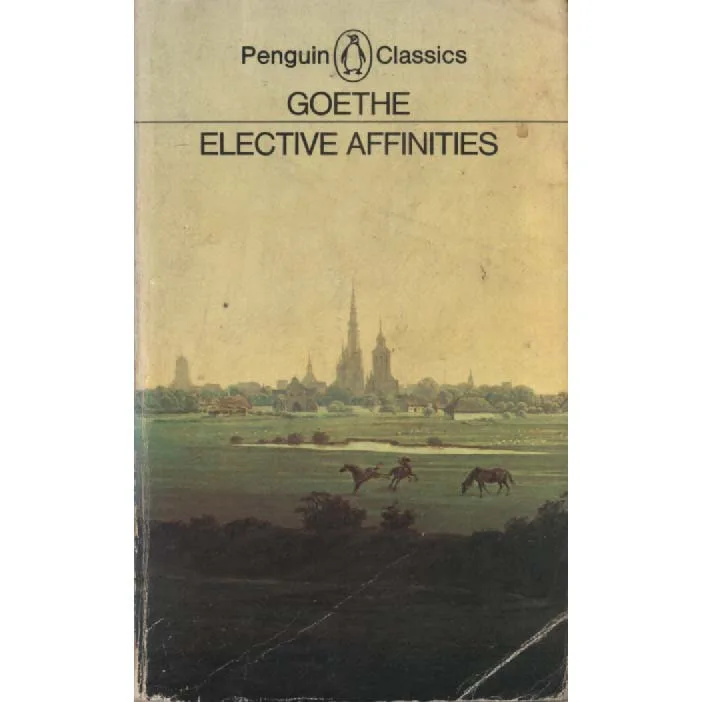
Publisher: Penguin Classics
Format: Paperback
ISBN: none
Elective Affinities (1971) – Goethe
Penguin Classics
ISBN: None. It predates the Age of Numbers-on-Backs.
Condition: Good, as tastefully weathered by Crappy Old Books.
Here it is: the novel in which Johann Wolfgang von Goethe looks at romantic relationships, glances over at chemistry, and says, “Yes. That. Let’s explain adultery with science.”
Elective Affinities is the story of a pleasant, well-ordered marriage that is going absolutely fine—
until two extra people show up and everyone’s emotional molecules start rearranging themselves in slow-motion disaster.
This is not beach-read infidelity with cocktails and witty comebacks. This is high-end German feelings, conducted on an estate with tasteful landscaping, moral seriousness, and occasional architectural notes.
What actually happens (in between the staring and the symbolism)
Roughly speaking, Goethe offers:
-
Eduard and Charlotte
Happily remarried, living their best country-house life. They have plans: landscaping, improvements, tasteful projects. Nothing could possibly go wrong. -
The Captain and Ottilie
The house guests. One is Eduard’s sensible friend; the other is Charlotte’s quiet, unnervingly intense young relation. They arrive. They stay. The emotional chemistry set falls off the table. -
Chemistry as fate
Characters are forever comparing themselves to chemical elements that combine, separate, and recombine according to invisible laws, which is both clever and deeply unhelpful when you’re trying to behave honourably. -
Long walks, long looks, long sentences
Gardening schemes, design projects, sudden spiritual crises, and pages where nothing “happens” except a devastating shift in who is thinking about whom, and how often. -
A slow-motion catastrophe
No screaming matches. Just polite conversations, quiet choices, and the steady erosion of the idea that people are fully in charge of their own hearts.
It’s part love story, part moral experiment, part “what if chemistry homework ruined a marriage?”
About the condition (Good, in the way the marriage isn’t)
This Penguin Classics copy is graded Good, which at Crappy Old Books means:
-
The iconic Penguin cover is intact and respectable, with only light scuffs or a modest crease—the literary equivalent of a slightly rumpled frock coat.
-
The spine is sound, perhaps gently lined with the history of previous readings, but in no danger of bursting into separate chapters like Eduard’s self-control.
-
The pages are complete, clean, and firmly attached, with just enough age-toning to whisper, “I remember when people quoted Goethe unironically at dinner parties.”
No loose signatures, no alarming stains, no tragic handwritten note saying “Never again” on the last page. Just a solid, well-kept classic that has clearly lived, but not suffered.
Why you might find this dangerously appealing
-
You enjoy fiction where the real action is internal, and the weapons are glances, hesitations, and politely phrased sentences that ruin lives.
-
You like the idea of a novel that asks:
“Are we free agents in love, or just chemicals doing what chemicals do?”
and then answers, “Good question. Let’s ruin everyone and find out.” -
You’re into 19th-century moral puzzles with a side of philosophy, landscape design, and doomed yearning.
-
You want to be the sort of person who says, “Well, in Elective Affinities…” and actually means it.
This is not a quick, fluffy read. It’s a quiet, precise dissection of desire, duty, and the stories we tell ourselves about being “reasonable.”
Why a “Good” used copy is exactly right for Goethe
Because:
-
A slightly worn Penguin classic feels reassuringly legitimate—like it has already sat through a couple of seminars and one over-ambitious book club.
-
Any soft corners or tiny creases are basically footnotes in physical form: someone else grappled with this before you.
-
You don’t have to treat it like a museum object. Scribble notes, dog-ear pages, underline that one passage that feels disturbingly modern. Goethe can take it.
If you find a faint pencil tick beside a particularly painful sentence, consider it a tiny, silent “same” from a previous reader.
The sales pitch disguised as a philosophical nudge
Elective Affinities isn’t here to give you a tidy moral. It’s here to make you mildly uneasy about:
-
How “harmless” attractions start.
-
How much control people actually have over their feelings.
-
Whether “we just couldn’t help it” is explanation, excuse, or both.
So here it is:
Elective Affinities (1971 Penguin Classics) by Goethe.
Elegant, unsettling, quietly merciless about human nature.
Condition: Good – structurally sound, emotionally hazardous.
Proudly circulated by Crappy Old Books.
Buy it. Read it. And then decide whether you truly believe in free will—or if you’re just another element waiting to react.
Keep browsing: See more Literary Classics books Other books by Goethe
